

Let’s be honest: most leadership teams dread the “weekly sync.” You know the feeling. You walk into a conference room or log onto a Zoom call, and for the next sixty to ninety minutes, you feel the life force being drained out of your business. People are checking their phones under the table, the same three important issues are rehashed without being resolved, and you leave the room with a to do list that looks exactly like the one you started with.
If you feel like you are wasting time in other meetings that could have been an email, you aren’t alone. Most meetings suck because they lack structure, accountability, and a clear agenda. They are often just a “status update” where people ramble about their previous week without ever actually discussing issues that move the company forward.
Enter the Level 10 Meeting™.
As a core component of the Entrepreneurial Operating System® (EOS®), the L10 isn’t just a meeting format. It is a tool designed to keep your leadership team on the same page, while holding each other accountable, and focusing on the most important issues facing the organization.
If your current meetings are hovering at a 4 or 5, here is how the entrepreneurial operating system EOS® and the L10 structured approach can significantly enhance your business.
The anatomy of an L10 meeting that actually works
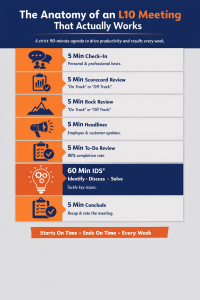
The L10 meeting is a strict agenda that lasts exactly 90 minutes. It starts on time, it ends on time, and it follows the same structured agenda every single week. By sticking to time limits, you prevent the “meeting bleed” that ruins productivity.
Here is the meeting agenda you can expect when you start running an L10:
- The check-in (5 Minutes). Every meeting begins with a quick personal and professional check in. This isn’t just small talk; it’s a way to transition from “doing” the work to “working on” the business. Each of the team members shares one personal best and one professional best from the previous week. This builds team health and ensures everyone is present and focused.
- Scorecard Review (5 Minutes) In the Entrepreneurial Operating System®, data is king. The Scorecard review is where you track progress on key metrics. This isn’t the time for discussions or problem solving. You simply state whether the numbers are “on track” or “off track.” If a number is off track, it gets dropped to the IDS® segment (more on that later) to be handled at the right time.
- Rock Review (5 Minutes) Quarterly priorities, known in EOS® as Rocks, are the 3 to 7 most critical priorities for the quarter. During the Rock review, each person states if their quarterly goals are “on track” or “off track.” Again, there is no discussing issues here. If a Rock is off track, it goes to the Issues list. This keeps the team focused on the organization’s vision without getting bogged down in the weeds.
- Employee and Customer Headlines (5 Minutes) This is where you share employee headlines or customer “wins” and “losses.” It’s a 5-minute pulse check to ensure the entire organization is aware of valuable feedback or pressing issues in the field. If a headline requires resolving issues, it moves to the agenda.
- To-Do Review (5 Minutes) The to-do review is the ultimate accountability tool. The note taker reviews the assigned tasks from the previous week. In a high-functioning Level 10 Meeting™, you expect a 90% completion rate. If To-Dos are consistently not getting done, it uncovers a deeper issue with accountability or capacity.
- IDS® (Identify, Discuss, Solve) (60 Minutes) This is the meat of the meeting. Most other meetings spend 90% of the time on updates and 10% on problem solving. The L10 flips that. For one hour, the leadership team focuses on resolving issues.
- Conclude (5 Minutes) The meeting ends by recapping the new action items, deciding if there are any key takeaways that need to be communicated to the rest of the company, and rating the meeting on a scale of 1–10.
IDS® (Identify, Discuss, Solve) is the ultimate meeting template
The IDS® (Identify, Discuss, Solve) method is what separates a Level 10 Meeting™ from a standard “waste of time” session. Most teams are great at discussing issues, but they are terrible at resolving issues. They talk in circles, but they never reach a decision making point.
Here is how the IDS® segment works:
Identify: You look at the list of important issues and the team picks the top three. You don’t start at the top of the list; you start with the most critical objectives. You must identify the root cause of the problem… not just the symptom.
Discuss: Once the root issue is identified, everyone gets to discuss it. This is where team members provide valuable insights. However, once everyone has had their say, you move quickly to the next step.
Solve: The leadership team agrees on solutions. This usually results in a new To-Do or an assigned task for a specific person. Once the issue is solved, it is removed from the list forever.
By using this structured approach, you ensure that the most important issues are actually put to bed, allowing the business to maintain momentum.
How the L10 meeting agenda helps your team hit quarterly goals

Transitioning to this Entrepreneurial Operating System® staple provides benefits that can significantly transform how your leadership team functions:
- Radical Accountability: When you have a scorecard review and a To-Do review every week, there is nowhere to hide. If you didn’t finish your assigned tasks, the whole team sees it. Not to shame any singular individual, but to align your team and ensure that your team efforts are moving toward the same objectives.
- Elimination of “Meeting Fatigue”: Because the L10 is so productive, it actually eliminates the need for most of your other meetings. When people know that there is a clear agenda and a designated time for problem solving, they stop “popping in” to offices or sending urgent Slack messages for things that can wait for the weekly meetings.
- Clear Owners and Action Items: How many times have you left a meeting wondering, “Wait, who is actually doing that?” In an L10, every solution results in a To-Do with clear owners. The note taker captures these action items in real-time, so when the meeting ends, everyone has a clear understanding of their next steps.
- Better Decision Making: By focusing on key components and key metrics rather than feelings, the executive team can track progress effectively and adjust strategies based on reality. It takes the emotion out of discussing issues and puts the focus back on effective problem solving.
Common “Rock Fails” and L10 Pitfalls
Even with clear agenda items, some teams struggle when they first attend an L10. Here are a few things to watch out for:
Too Many Rocks: If your leadership team has too many Rocks, you will never stay “on track” during the Rock review. Focus on the highest priority goals only.
Falling Into “Update Mode”: If you spend 40 minutes on the scorecard review, you are wasting time. The first 25 minutes of the meeting should be a “no-discussion” zone. Save the talk for the IDS® segment.
Not Solving the Root Cause: If the same pressing issues keep appearing on your list week after week, you didn’t actually solve them. You likely just discussed the symptoms. Go back to the IDS® segment and identify what is really broken.
Lack of a Note Taker: Without someone to track progress and document the To-Dos, the valuable work done in the meeting will vanish the moment you walk out the door.
How to start running a Level 10 Meeting™ today
You don’t need to wait for a new quarter to start running better meetings. You can implement the L10 meeting format this coming week.
- Set the Time: Pick a day and time that is “sacred.” It should be the same time every week.
- Assign Roles: You need a leader to move the agenda along, a note taker to record To-Dos, and a timekeeper to enforce time limits.
- Build Your Issues List: Start a running list of issues ahead. Encourage team members to add to it throughout the week so you don’t forget important issues.
- Review the Scorecard: If you don’t have a scorecard yet, pick 5–15 key metrics that tell you if the business is healthy.
- Commit to the Process: It takes just a little practice to get the rhythm right. Don’t give up if the first few feel clunky.
Driving business success through structure

The Entrepreneurial Operating System® EOS® is built on the idea that vision without traction is hallucination. The Level 10 Meeting™ is the “traction” part of that equation. It is the heartbeat of your organization that thrives on other components being solid. For example, a strong Scorecard with activity-based metrics is essential for identifying when goals are off track.
When you move away from a To-Do list that never ends and toward a structured approach for resolving issues, you significantly enhance the health of your team. You’ll find that you have more time to focus on business growth, customer satisfaction scores, and strategic planning.
Weekly meetings shouldn’t be a waste of time. They should be the most valuable 90 minutes of your week. By implementing the L10, you aren’t just changing a meeting format; you are changing the culture of your company. You are moving from a group of people who “talk about work” to a coordinated effort of leaders who solve issues and move the business forward with impactful results.
Stop wasting time and start resolving issues that matter. Your leadership team, your employees, and your bottom line will thank you.
Ready to transform your leadership team’s productivity? If you’re realizing that your current meeting style is holding back your business growth, I can help you implement the EOS® framework.
Join my Group Workshop to see a live demonstration of an L10 in action. Book a 1:1 Strategy Session to build your first Scorecard and Accountability Chart™.
