

Let me tell you something that might sting a little: most business owners are flying blind, and they don’t even know it.
I see it every week in boardrooms across the country. Smart, successful entrepreneurs making decisions based on gut feelings, outdated reports, and whatever fire is burning brightest that day. They’re working harder than ever but can’t tell you if they’re actually winning or losing until it’s too late to do anything about it.
If this sound familiar, don’t worry I’ve been there too… and I’m about to show you exactly how to fix it. It only takes one simple tool to turn these businesses around – The EOS® (Entrepreneurial Operating System®) Scorecard
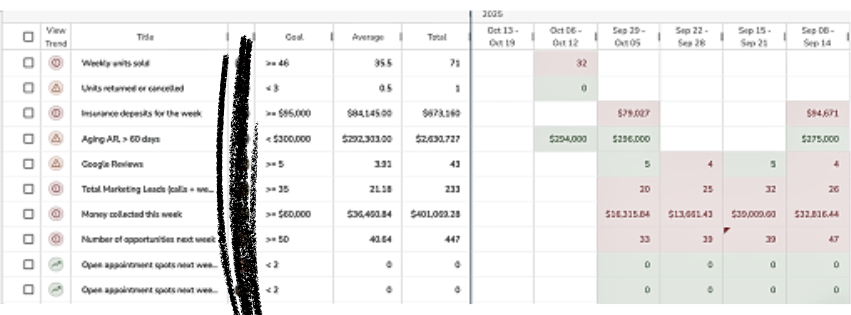
The EOS® Scorecard like the one here (my clients’ images have scribbled over for their privacy btw) brings clarity to your business performance, helping you see exactly where you stand and what needs attention. Ultimately, the tool acts as your business GPS, giving you a real-time pulse on your company’s health so you can make informed decisions quickly.
The wake-up call that changes everything
Picture this: You’re three months into your quarter, feeling pretty good about how things are going. Then your accountant drops the monthly financials on your desk, and your stomach drops. Revenue is down 15%, costs are up, and you have no idea how you got here.
This scenario plays out in businesses everywhere because we’ve been trained to manage by looking backward instead of forward. It’s like trying to drive by staring in the rearview mirror…you’re guaranteed to crash.
That’s where the EOS® Scorecard acts as your business GPS. It doesn’t just tell you where you’ve been; it shows you exactly where you’re heading and gives you time to change course before you hit the wall. The EOS® Scorecard provides valuable insights into your key metrics, helping you make proactive decisions to improve performance.
Why an EOS® Scorecard is your secret weapon for transformation
The thing is: the EOS® Scorecard isn’t another dashboard to impress your board. It’s a weekly reality check that tracks 5-15 numbers across core business functions and actually move the needle in your business. Think of it as your company’s vital signs…the metrics that, when healthy, guarantee everything else falls into place. An effective scorecard ensures focus on what matters most, so your team isn’t overwhelmed by irrelevant data.
Why Weekly? Because by the time monthly reports come out, the game is already over. Tracking on a weekly basis means that you don’t have to wait until the end of the month to notice a developing pattern. You can catch problems when they’re still solvable and capitalize on opportunities while they’re still hot.
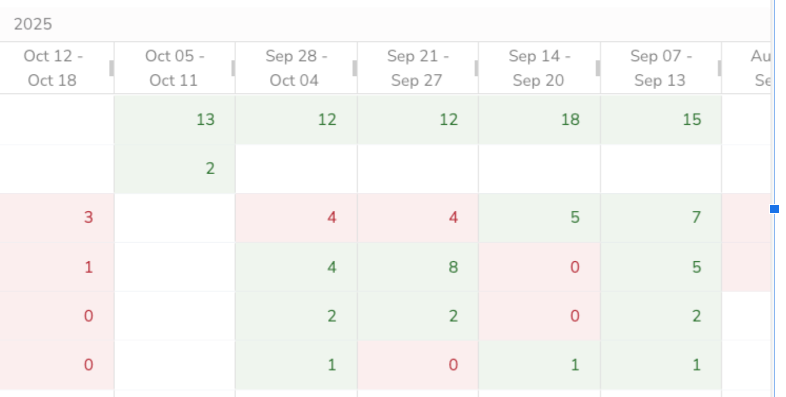
Why Leading Indicators? Because you can’t change yesterday, but you can absolutely influence tomorrow. Instead of mourning last quarter’s missed targets, you’re taking action on next quarter’s wins.
Why across Core Business Functions? You should only track 2-3 metrics from each core business function (e.g marketing, sales, operations, finance) because these activity-based metrics focus on the critical/most sensitive points in the business. These are activities which if changed, can effect the biggest changes across your business and get you back on track before hitting the bottom line.
Why Clear Ownership? Because “everyone’s responsible” means nobody’s responsible. Each number has one owner who reports it, alerts the team whether the weekly status is “on track” or “off track”, and fixes it when it goes sideways. Clear ownership drives accountability, ensuring that team members are responsible for results and follow-through.
Together, these elements create an effective scorecard that drives focus, accountability, and measurable results.
Key metrics to track: real examples from real businesses
Let me share some examples of scorecards from clients who’ve transformed their businesses with this discipline. Each case is an example of how the EOS® Scorecard can be applied in real-world situations. (Names have been changed, but the results are 100% real).
For each business, I’ll highlight some industry-specific EOS® scorecard examples and items they tracked to drive results.
Weekly EOS Scorecard Examples – SaaS company
Sarah’s SaaS company tracks key metrics weekly to drive sales and marketing success:
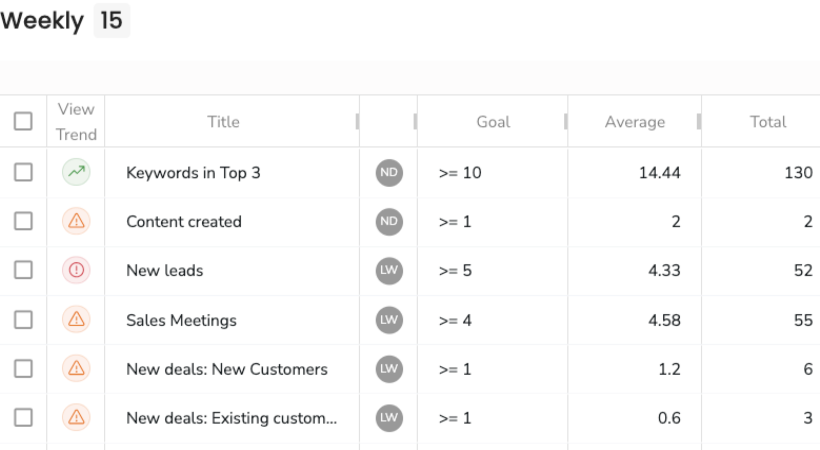
- Keywords in Top 3 (Target: >10 per week)
- Content created (Target: > 1 per week)
- New leads (Target: > 5 per week)
- Sales meetings (Target: > 4 per week)
- Average deal size (Target: $15K)
- Marketing qualified leads (Target: 30 per week)
- Customer acquisition cost (Target: Under $2,500)
These activities, including client proposals and other key metrics, are carefully measured to ensure accountability and continuous improvement.
What worked for Sarah’s team: Instead of wondering why revenue was down at month-end, Sarah’s team knew by Wednesday if they were off track and could course-correct immediately. Result: 145% revenue growth in 18 months.
Weekly EOS® Scorecard examples – Audiology practice
Gary’s audiology practice measures what matters for their operations department, but remember, different departments may have their own scorecards:

- Weekly units sold (Target: > 46)
- Units cancelled (Target: < 3)
- Google reviews (Target: > 5)
- Total marketing leads (Target: > 35)
- Money collected (Target: > $60,000)
Other departments, such as HR or finance, may track different metrics tailored to their specific goals and priorities.
The breakthrough moment was when Gary’s team realized their quality issues weren’t random…they happened every Tuesday when their best technician was off. Simple fix, massive impact.
Weekly EOS® Scorecard example – Consulting
Jennifer’s podcast consulting firm tracks these leading indicators:

- New leads generated (Target: > 7 per week)
- Podcast outreach touches (Target: > 5 per week)
- Proposals guest scheduled (Target: > 1 per week)
- Retainer deposit amount (Target: $6500 per week)
- Clients converted (Target: > 3 per week)
Jennifer soon found out that assigning clear metrics to each team member ensured individual accountability and helped track performance across the firm. Monitoring employee engagement also supported a positive work environment and drove continuous improvement.
When she discovered that her best projects came from referrals, Jennifer built a systematic referral process that doubled her pipeline in six months.
Industry-Specific Scorecards That Drive Results
Digital Health Startup (my favorite success story)
Let me tell you about Alex, founder of a telehealth platform. When we started working together, he was drowning in data but starving for insight. His team was tracking everything…website traffic, app downloads, social media likes….but missed the relevant metrics that actually predicted success.
When Alex hired me as an EOS® implementer, we immediately focused on relevant data points crucial to aligning performance with company goals.
Here are the scorecard metrics that changed everything, tracked weekly:
Weekly measurables:
- New patient registrations (Target: 150)
- Patient activation rate within 7 days (Target: 65%)
- Provider utilization rate (Target: 75%)
- Monthly recurring revenue growth (Target: 18%)
- Customer acquisition cost (Target: Under $120)
- Patient engagement score (Target: 4.2/5)
- Platform uptime (Target: 99.5%)
The transformation: In 15 months, Alex’s company went from burning cash to profitability, increased patient registrations by 250%, and secured Series A funding…. all because they stopped celebrating vanity metrics and started measuring the scorecard metrics that directly correlated with sustainable growth.
How to build your scorecard without losing your mind
Step 1: Get brutally honest about what actually drives your business
I always start with this question: “If you could only track 3 key numbers capable of driving your business forward, what would they be?” Not what looks impressive in a board deck, not what your industry magazine says you should track…what key numbers, if managed well, would guarantee your success?
Here’s how we find them:
- Revenue Drivers: What activities (e.g client acquisition) directly generate money? It’s important to measure these drivers to understand their impact.
- Efficiency Indicators: What shows you’re getting better, faster, cheaper? Measure these to track improvements over time.
- Quality Measures: What proves you’re delivering value? Measuring quality is key to ensuring client satisfaction.
- Growth Signals: What predicts future success? Measure these signals to anticipate and plan for growth.
Implementing your scorecard based on these key measures ensures you are tracking what matters most for your business success.
Step 2: Choose numbers that predict the future

This is where most people mess up. They track lagging indicators (what already happened) instead of leading indicators (what’s about to happen). The numbers you choose here should be EOS scorecard metrics…specific, measurable indicators that align with your business goals and help drive agency performance.
Lagging Indicator: Monthly revenue Leading Indicator: Sales activities that create revenue
Lagging Indicator: Customer satisfaction scores Leading Indicator: Response time to customer issues
Lagging Indicator: Profit margin Leading Indicator: Cost per unit and pricing decisions
Step 3: Set targets that matter
Your targets should make your team stretch but not snap. Too easy, and nobody grows. Too hard, and everyone gives up. I use this test: “Is this number achievable with focused effort?” If yes, and if hitting it consistently would make your business significantly better, you’ve got a winner. I also like to ask “what does a successful week look like to you in your role”? Your vision of successful should guide you towards where you priorities should lie
Step 4: Own your numbers
Every number needs exactly one owner. Not a team, not a department… just one person who wakes up thinking about that metric and goes to sleep planning how to improve it. The leadership team plays a key role in assigning ownership of these metrics, ensuring clear accountability.
The owner:
- Reports the number every week
- Explains why it’s red when it misses target
- Takes action to get back on track
- Has the authority to influence the outcome
Step 5: Make it a discipline, not an event
Discipline beats talent every single time. Leadership teams must model the discipline of regular scorecard review. The magic isn’t in having a scorecard; it’s in using it religiously every week.
How to do a weekly scorecard review in 5 mins:
- Go through each line item
- Answer the question “on track” or “off track?”
- Done.
Total time investment: 5 minutes or less. No need for an extra meeting – you get this done inside your L10 meeting. “Off track” metrics get dropped into the “Issues List” where they get prioritized in IDS.
Mistakes that kill scorecards (And how to avoid them)
Mistake #1: The Kitchen Sink Approach
I’ve seen scorecards with 47 metrics. Guess how many of them drove real change? Zero. When everything is important, nothing is important.
The fix: Start with 8-12 metrics max. You can always add more later, but you can’t get focused if you’re tracking everything.
Mistake #2: Vanity Metric Addiction
Social media followers, website page views, email subscribers…these might make you feel good, but do they make you money? Track metrics that have a clear line to business results.
The fix: For every metric, ask: “If this number improves by 20%, will our business be measurably better?” If you can’t answer yes with confidence, cut it.
Mistake #3: The Moving Target Problem
I see this constantly: teams change their targets every time they miss them. That’s not management; it’s wishful thinking.
The fix: Set targets based on data and stick with them for at least one quarter. If you’re consistently missing, the problem isn’t the target—it’s the system.
Mistake #4: The Blame Game
When numbers go red, weak leaders look for someone to blame. Strong leaders ask, “What broke in our system?”
The fix: Make it safe to report bad news early. Reward people who surface problems quickly, not those who hide them until they explode.
Getting Started: Your four-week implementation plan

Week 1: Foundation
- Identify your 8-10 most critical metrics
- Set specific, measurable targets
- Assign clear ownership
- Choose your tracking tool
Week 2: Launch
- Collect your first week of data
- Hold your first scorecard meeting
- Celebrate what’s working
- Address what’s not
Week 3: Refine
- Adjust targets based on reality
- Add or remove metrics as needed
- Strengthen your weekly discipline
- Start taking action on red items
Week 4: Optimize
- Look for patterns in your data
- Fine-tune your review process
- Address systemic issues
- Plan for continuous improvement
The Bottom Line: Why This Changes Everything
Here’s what I know after helping hundreds of businesses implement EOS® Scorecards: The companies that commit to this discipline don’t just survive…they dominate their markets.
They make better decisions because they have better data. They catch problems early because they’re looking ahead, not behind. They execute faster because everyone knows the score.
Most importantly, they win together because everyone is aligned on what success looks like and how to achieve it.
Your scorecard is your competitive advantage.
The question isn’t whether you have time to implement this system. The question is whether you have time not to. Because while you’re flying blind, your competitors might be flying with instruments.
Ready to see clearly? Start building your scorecard this week. Your future self…(and your bank account) will thank you.
Want to dive deeper into EOS® implementation? Connect with me to explore how we can get your team aligned, accountable, and winning together.

2 Responses