

When you run a service business…whether it’s a medical clinic, a law firm, a vet practice, or a creative agency you’re scaling…your core product isn’t sitting on a warehouse shelf. Your product is how well your people execute. It’s basically your team’s expertise, time, and the quality of the customer experience they deliver every single day.
In the early days of scaling a service business, hiring is mostly about survival. When it’s just you (maybe plus a tiny core team), you don’t have well-defined internal processes or detailed standard operating procedures. You hire likeable people, hope they can get the job done, assign them a job title, and rely on assigning tasks in person to keep everyone aligned. Maybe you share lunch, talk through issues in real time, and personally make sure your customers get incredible service so you can build stronger relationships, earn social proof, and generate more revenue.
Here’s what usually happens early on: you hire the talent you can afford. That often means less experienced people who need more training, more managing, more of your time and energy to bring up to speed. There’s nothing wrong with that…it’s basically how most businesses start. But it means you have to go in eyes open about what you’re really taking on.
Then the business grows. You invest more in marketing, bring in new leads, win new clients, and hire people to handle the volume. But suddenly, that informal way of managing everyone doesn’t cut it anymore. You can feel it, you’re just not sure what to do differently. And let’s be honest, no one ever taught you how to run a business. Your training is in your craft… in the thing you’re actually great at.
If nothing changes at this point, friction starts showing. Maybe it’s between team members, maybe it’s between you and them. Morale dips, and the quiet venting sessions in the breakroom begin. The workload feels heavier for everyone, but usually it’s you who feels the real squeeze, because you’re the one holding the entire business on your shoulders while the team doesn’t quite see it yet.
When this happens, most founders think they have a hiring problem, or that they just need to work harder to keep everyone happy. So they throw money at new tools. They run a random team-building day. They hire even more people to cover the load. But none of it touches the real issue, which is the underdeveloped or weak structure underneath.
Here’s the deal. Adding more people and investing in shiny new tech platforms on top of a broken, undefined structure doesn’t fix it. It just makes the mess bigger. It’s not to say that those two things aren’t needed, but when there’s weak structure underneath and no system to support how you scale and operate the business, these investments can fall flat.
If you want to get out of the bottleneck, stop working 65-hour weeks, and build a service business that actually generates more margin, you have to get brutally honest about your team. Not harder on them. Honest about them. But first, you’ve gotta get clear on what success actually looks like, and the structure that gets you there over the next 12 to 18 months. That starts with a simple, objective way to get the Right People in the Right Seats.
The Hidden “Dumb Tax” of Tolerating People Issues
In a recent discussion with my friend Jodie Layne on the Beyond Hormones podcast, we discussed a concept from Keith Cunningham’s book The Road Less Stupid: the concept of accumulating “dumb tax”. Basically, this is the cumulative financial and emotional cost of making silly decisions or ignoring obvious problems because you’re moving too fast to deal with it. Or because you know something isn’t working, you just don’t know what to do about it yet. And in a growing service-based business, the single biggest “dumb tax” you will ever pay comes from tolerating people’s issues.
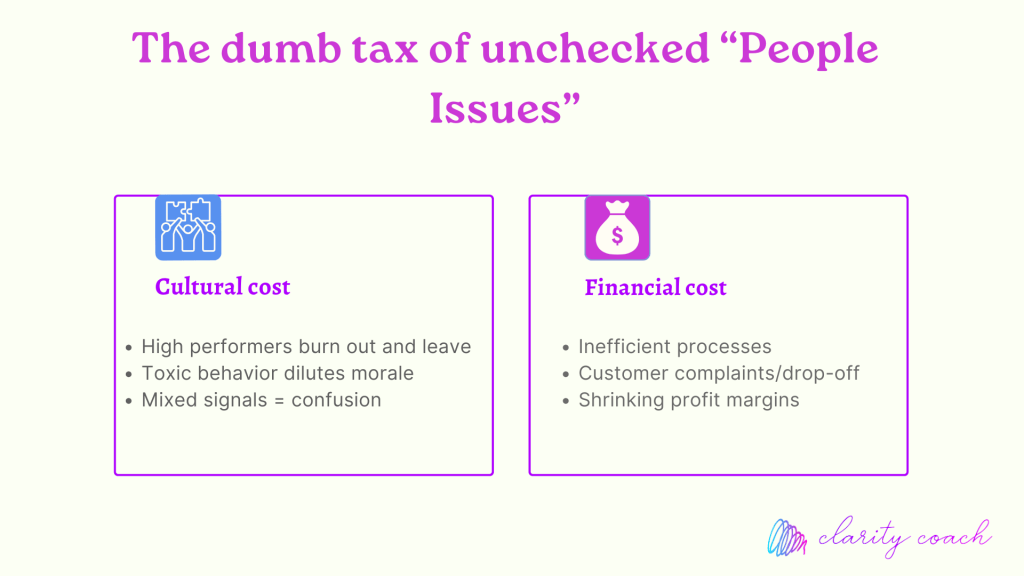
When you are trying to scale a service, tolerating low performance or cultural misalignment will erode your profit margins/company culture, guaranteed.
Think about what happens when you tolerate an employee who consistently misses deadlines, forgets to complete time-consuming administrative follow-ups, or treats colleagues disrespectfully:
- You burn out your A-players or yourself if the team is small, because your high performers end up absorbing the extra workload, doing the same work twice to fix mistakes, and quietly looking for the exit.
- Your delivery depends on being seamless and reliable. When roles are fuzzy and expectations aren’t enforced, clients feel the friction. Customer complaints rise and customer retention or referrals drop.
- The money you’re pouring into new leads, or the equipment you bought to level up the practice all goes to waste. Leads don’t get followed up and conversion eventually slips. You’re burning cash on qualified prospects who walk right back out the door.
- You remain the bottleneck. If your team isn’t stepping up to fully own their roles, every single problem, client escalation, and piece of friction lands directly back on your desk. So you stay trapped in daily firefighting instead of focusing on high-level growth strategy, financial management, and exploring new markets.
Breaking the cycle starts with one shift. Your gut got you this far… but it won’t get you the next 12 months. You need something objective to evaluate your team, not just a feeling in your stomach.
The two types of people problems
When I work with owners and their leadership teams as an EOS Implementer® and business coach, we cut through the noise around people and culture and get to the real question: do you have the right people, and are they in the right seats? Because when it comes to your team, there are really only two types of people problems:
- Right Person, Wrong Seat
- Wrong Person, Right Seat
Understanding the difference between these two scenarios makes a huge difference in how you lead, coach, and make tough personnel decisions.
1. Right Person, Wrong Seat
This is someone who completely embodies your company’s core values. They care deeply about your business goals, they show up with great energy, and they live your culture… so naturally, everyone loves working with them.
However, they are simply not producing results in their current role. As your business grows, the complexity of their job has outpaced their current skill set, technical capacity, or natural abilities. They are struggling to handle larger projects, keep up with capacity management, or deliver consistent service.
Because they are a “Right Person,” you don’t want to lose them from your organization. The goal here is to determine if there is another seat in the business where their unique talents and abilities can shine.

P:S Now, this assumes you’ve actually defined your company’s core values (and honestly, most owners haven’t). Or if they have, one of two things is true. Either they wrote them once, and they’ve been collecting dust ever since. Nobody hires, fires, or coaches by them. Or they’re aspirational – a list of who you wish you were, not who your team actually is on a Tuesday afternoon. That’s normal, and it’s some of the first work we do together in vision planning, when we answer the 8 questions on the V/TO™.
Real core values aren’t slogans for the wall. They’re the actual DNA of how your people already show up. And you can’t tell if someone’s a “Right Person” until you’re clear on that.
2. Wrong Person, Right Seat
This is the single most dangerous person in any growing company.
This is the “star producer”…the lead provider/practitioner or team member who generates high revenue, the top-selling consultant, or the brilliant technical specialist who gets named in positive client feedback. On paper, their key performance indicators look fantastic.
However, culturally, they are a nightmare. They gossip, ignore company policy, refuse to follow your documented standard operating procedures, treat support staff poorly, or act as if the rules don’t apply to them.
Most business owners are terrified to deal with a “Wrong Person, Right Seat” because they think: “If I fire them, my revenue will drop instantly!”
Here is what you must understand: a Wrong Person in a Right Seat is a cultural cancer.
By keeping them around, you are sending a clear message to the rest of your organization that numbers matter more than core values. They erode trust, destroy morale, and drive away your true A-players. Over time, keeping a toxic high-performer costs you far more in turnover, lost productivity, and management headaches than their individual output is worth.
Structure First, People Second: The Accountability Chart™
To fix people problems permanently, you cannot start with the individuals currently sitting in your company. You have to step back and look at what the business actually needs. In traditional corporate models, companies rely on org charts.. These are often driven by titles and super vague about who actually owns what. In EOS®, we throw out traditional org charts and build an Accountability Chart™.
The golden rule of building an Accountability Chart™ is simple: Structure first, people second.
Before you put anyone’s name in a box, you must ask: “What structure does this business need over the next 12 to 18 months to execute our long-term business goals and achieve sustainable growth?” This might be different than what it looks like today.
For most service companies, the foundational structure boils down to three core operational functions, overseen by an Integrator (the operational leader who harmonizes the functions):
- Sales & Marketing: Responsible for generating more leads, acquiring more clients, building marketing strategies, converting leads to new active clients or patients if you’re in the professional services world, and driving top-line growth.
- Operations: Responsible for service delivery, maintaining clinical/technical quality, ensuring high customer satisfaction, managing current resources, and managing daily client workflows and contributing to profitability and efficiency.
- Finance & Administration: Responsible for cash flow, billing, financial tracking, sometimes IT, human resources get lumped in, and keeping the business legally and financially healthy.
Once you’ve defined the major seats your business needs, you name three to five core accountabilities for each one: the outcomes that seat exists to drive.
This sounds like a quick exercise, the kind of thing you’d knock out in an hour. It rarely is. With the leadership teams I work with, we usually spend a few hours just getting this right at the top level.
The goal isn’t a ten-page job description full of minor tasks. It’s the five primary outcomes that seat must own from start to finish. When every seat has that kind of clarity, the vagueness disappears. Everyone knows who owns what, where the hand-offs are, and what success looks like.
And this isn’t just for junior hires. Even a seasoned hire that demands a greater investment needs you to be crystal clear about the 3 to 5 things the business is counting on them to own. Not vague hopes, specific, measurable outcomes they’re driving week to week. Experience doesn’t remove the need for clarity. It just changes what you’re measuring.
I like to ask the simple question: What are the 3-5 high-level things the business relies on this “seat” for?
The GWC™ Filter: Does Your Team “Get It, Want It, and Have the Capacity”?
Once your Accountability Chart™ is built and your core seats are clearly defined, you can evaluate whether the person sitting in each seat is genuinely capable of executing those 5 accountabilities.
To do this objectively, we use a simple three-part filter called GWC™:
1. Gets It (G)
“Gets It” means they truly understand the seat, they’re good at this work and have experience doing it, and how their role fits into the larger organization. It’s a natural, intuitive grasp of what the job requires.
2. Wants It (W)
“Wants It” means they have a genuine passion for the work that the role entails. It’s a Heck Yeah! They get up in the morning excited to take on their accountabilities, solve operational issues, and help the company succeed. You cannot force someone to want a job. If you have to constantly bribe, plead, or micro-manage an employee to do their basic tasks, they do not “Want It.”
3. Capacity to Do It (C)
“Capacity” refers to whether they have the physical, mental, and emotional bandwidth, and just as important, = the skills, and competencies , and time needed to do the job exceptionally well. Well being the operative word.
Sometimes an employee “Gets It” and “Wants It,” but as your company scales from $2M to $10M, the seat simply grows too big for them. They don’t have the capacity to manage a larger team, oversee larger projects, or analyze complex data.
GWC™ is an absolute yes-or-no evaluation. If the answer to any of those three letters is “No,” that person is in the wrong seat.
How to Use the People Analyzer™ to Take the Emotion Out of Management

Now that you understand Core Values (Right Person) and GWC™ (Right Seat), how do you put them together into a practical tool you can use every day?
We use the People Analyzer™. The People Analyzer™ is an incredibly effective, simple tool that combines your core values with the GWC™ filter to give you a clear, visual snapshot of your team’s health.
Here is how you use it:
- List Your Core Values Across the Top: Write down your 3 to 5 core values. These shouldn’t be aspirational slogans; they must represent the true DNA of your culture.
- List Your Team Members Down the Side: Write out the names of your leaders and direct reports.
- Grade Each Person on Core Values: Use a simple plus/minus scale:
- Plus (+): They exhibit this core value most of the time (80%+).
- Plus/Minus (+/-): They exhibit this value inconsistently (about 50/50).
- Minus (-): They rarely exhibit this core value.
- Grade Each Person on GWC: Answer “Yes” or “No” for Gets It, Wants It, and Capacity.
Setting “The Bar”
As a leadership team, you establish a minimum acceptable standard called “The Bar.” For example, your bar might be that every employee must receive all “Pluses” on core values (with no more than one “+/-” and zero “Minuses”), and a “Yes” on all three letters of GWC.
If anyone falls below The Bar, you no longer have a vague, emotional feeling that “something isn’t working.” You have clear, objective data showing precisely where the gap lies.
The Quarterly Conversation™: Making It a Two-Way Discipline
The People Analyzer™ isn’t a secret tool you use to judge people behind closed doors. You use it openly as part of a quarterly check-in rhythm called the Quarterly Conversation™.
Every quarter, you sit down 1-on-1 with your direct reports. Ahead of the meeting, both you and the employee complete a People Analyzer™ evaluation on their performance.
During the meeting, you compare notes. Sometimes the gap is capacity:
“I noticed we both gave you a ‘Yes’ on Gets It and Wants It, but you gave yourself a ‘No’ on Capacity. Let’s talk about what’s clogging your plate and where we can streamline your processes.”
Other times it’s a behavior that doesn’t match a core value:
“Your production numbers are great. But I gave you a ‘Minus’ on our core value of “We Do What We Say We’re Gonna Do”. You committed to having the onboarding docs done by last Tuesday and they didn’t land, and it’s the third time this quarter. Let’s talk through what’s getting in the way and how we fix it”
From there, the manager and direct report walk through the rest: progress on their 90-day goals, or Rocks, and their weekly scorecard numbers for the quarter.
This simple exercise takes the fear and emotion out of feedback. It turns an awkward review into a productive coaching conversation, one focused on helping your team bring their best selves to work.
Your Action Steps This Week
Scaling a service business requires moving from informal grit to intentional, structured leadership. If you are ready to fix your people issues and build an accountable team, here are 4 things you can start this week:
- Define Your Core Values: If you haven’t already, get crystal clear on the 3 to 5 core values that define your culture. Make sure they reflect who you actually are, not who you wish you were.
- Build Your Draft Accountability Chart™: Forget who currently works for you. Draw out the functional seats your company needs over the next 12 to 18 months to achieve your business goals. Define the 5 major accountabilities for each seat.
- Run Your Team Through the People Analyzer™: Evaluate your leadership team against your core values and GWC™. Identify if you have any “Right Person, Wrong Seat” or “Wrong Person, Right Seat” issues that you’ve been tolerating.
- Start scheduling a regular cadence so these tough conversations don’t feel like a surprise: Stop accumulating “dumb tax.” Use the People Analyzer™ to have an honest, compassionate, and objective conversation with anyone falling below The Bar.
In Part 3 of this series, we will focus on execution, data, and technology….specifically how to install a weekly Scorecard, establish 90-Day Rocks™, and leverage tech automation as a strategic Rock to build a predictable, $10M enterprise .
👉 Ready to see where your business is dropping the ball? Take my 5-Minute Leadership Gap Assessment to objectively evaluate your operational foundation across these core areas!
