

I sat across from the founder of a healthcare SaaS company — let’s call him David. His business had flatlined on growth and just lost their biggest client, 30% of recurring revenue, in the same year. On paper, they were a loyal, hardworking team. In reality, the business was being held together by one person.
It had been 18 months since David promoted a loyal, long-tenured employee into a VP role. This leader had built five different billing systems over those 18 months — none of them clean, all of them overlapping. He never took a vacation. Not because he was dedicated, but because the business would have broken without him. He looked like a hero. He was actually a single point of failure — and nobody, including David, had ever named it clearly.
Customer complaints kept landing in David’s inbox. Payments were slipping through the cracks. Execution had slowed across the organization. And the high salary David had granted this leader was weighing heavy on their bottom line.
The initial pride David felt in promoting from within had quietly curdled into something harder to name. He was beginning to realize he was looking at a classic Right Person, Wrong Seat problem — and he’d been avoiding it for far too long.
As Jim Collins famously said, getting the right people on the bus is the start. But if you put the right person in the wrong seat, they’ll eventually drive the bus into a ditch.
That’s exactly what was happening.
Understanding the Seat
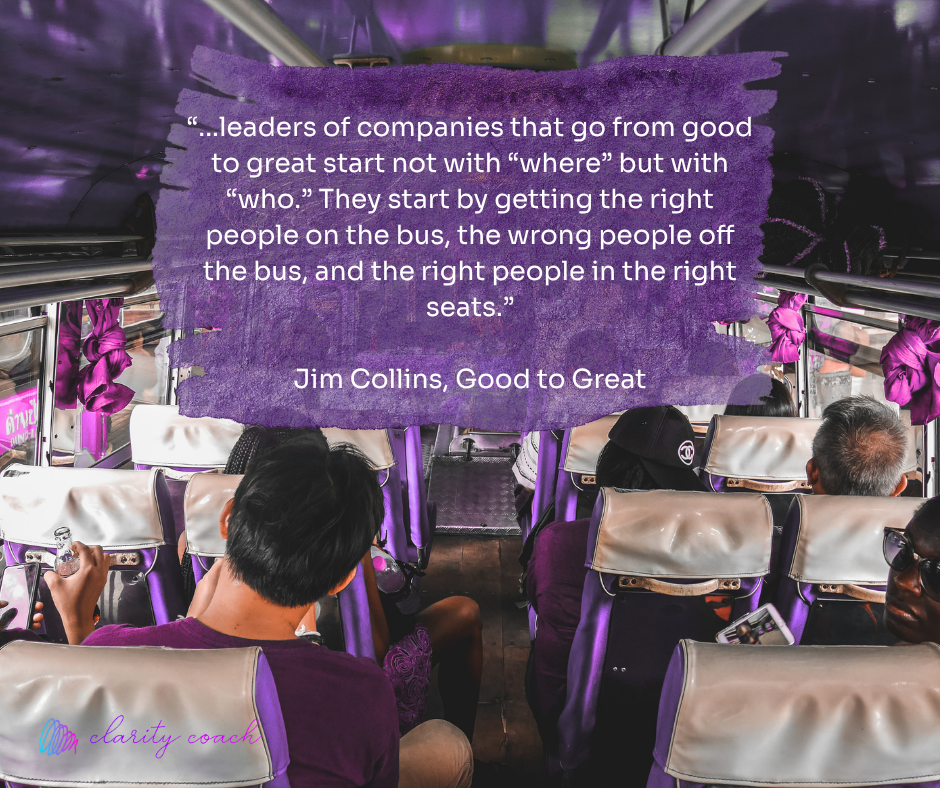
While Jim Collins wrote about getting the “Right People on the Bus” in Good to Great, the specific distinction of “Right Person, Right Seat” is a hallmark of Gino Wickman’s EOS® (Entrepreneurial Operating System), outlined in his book Traction.
The framework breaks down like this:
Wrong Person, Right Seat: You have someone who doesn’t align with (or exemplify) your core values. Even when they are a “nice” or relatable person, if your culture is built on integrity but they cut corners to get results, they are the wrong person for your organization.
Right Person, Wrong Seat: This is David’s dilemma. You have someone who fits the culture perfectly, but they don’t GWC™ the seat (more on this shortly).
David had a “Right Person,” but the new seat demanded a Capacity that simply wasn’t there. One could also argue that they were weak in how they solved for issues: treating the symptoms and avoiding addressing problems at the root cause. But by trying to reward loyalty with a promotion, he had accidentally set this employee (and the business) up to fail — and kept him there for 18 months while the business quietly paid the price.
Mastering the People Segment: Structure First, People Second

In The Entrepreneurial Operating System®, we use two foundational tools to strengthen the People Segment of the 6 Key Components™: The Accountability Chart™ and the People Analyzer®. But even with these structures, I sit with many business leaders who tolerate “wrong person in the wrong seat” issues for too long. The domino effect of this indecision is costly. A key difference between 10x growth companies and those that stall is that high-growth leaders are decisive regarding RPRS issues. To build a 10x company, you must operate as a 10x leader.
Whether you have recently acquired a business or have 30+ employees but find yourself making every single decision, you must first ask: Do you have a people problem, or a structure and clarity problem?
Here are three use cases for putting these tools into action:
-
- Design mode: before making hiring decisions
-
- Diagnostic mode: identifying the gaps
-
- Development mode: ongoing strategic leadership disciplines
1. Build the Structure: The Accountability Chart™
The Accountability Chart™ is a strategic tool used to define business needs for the next 6–12 months and move your organization forward in the right order: structure first, people second. It focuses on the business’s core functions at the leadership level and is built from the top down.
Most businesses require the same core functions: Sales/Marketing, Operations, and Finance. Design these seats for where the business is going, not how it functions today. For each seat, define 3–5 key accountabilities — not tasks or activities. Ask yourself: what would you measure to determine the success of this seat? Those answers eventually connect to your Weekly Scorecard.
2. Evaluate Fit: The People Analyzer™
Once the seats are defined, we use the People Analyzer™ to evaluate if an individual is the “Right Person” and if they GWC™ the seat. This means they fit your culture and live your Core Values consistently.
Rank candidates with +/- against each core value:
-
- (+): They exemplify the value 100% of the time.
-
- (+/-): They exemplify it 50% of the time.
-
- (-): They exemplify it less than 50% of the time.
Any (+/-) or (-) is a culture fit issue that must be addressed through a clear, honest conversation. In practice, run the People Analyzer quarterly as a team and as part of quarterly conversations with direct reports — not because something is broken, but because it creates a shared language for how people show up and normalizes the conversation before it becomes a hard one.
3. The GWC™ Framework: Are They in the Right Seat?

Even if someone is a “Right Person,” they must also be in the “Right Seat.” We determine this by asking three questions: Do they Get it, Want it, and have the Capacity to do it?
Do They “Get It”? (G)
“Getting it” is about natural ability and insight. They instinctively understand their role as it relates to the overall mission. Maria, a sales manager candidate, immediately understands the need to balance team motivation with hitting targets and proactively suggests strategies — she “gets it.” John focuses only on daily tasks and needs constant reminders about the bigger picture — he doesn’t.
In David’s company, the promoted leader wanted the new title and the opportunity to serve on leadership. But he didn’t “get” it. He lacked the experience to strategically build solutions that scaled. He couldn’t build and maintain systems that moved the business from point A to point B — and it showed.
This mental “click” — where a candidate genuinely understands the responsibilities and vision of a high-level leadership role — usually comes from having done that work before. When experience isn’t there, it requires intentional mentoring, coaching, and training. The problem is most entrepreneurial leaders don’t have the bandwidth to provide that, and business results begin to suffer while they wait for the person to catch up.
Do They “Want It”? (W)
This is about passion and internal motivation. They enjoy the work, and it aligns with their goals and desires — including all aspects of the role, not just the title or the paycheck.
I was once in the room with a leadership team running a multi-location medical practice on a self-pay model. One of their key metrics was patient help rate — meaning, if a patient left without receiving care, the goal wasn’t met. One clinician was deeply patient-centric and passionate about education and counseling, but their help rate was consistently underperforming. When the manager offered feedback, they were met with resistance. This clinician didn’t want to “sell” their services — a core part of the role. They didn’t “want” all of what the job required. They parted ways, and everyone was better for it.
Do They Have the “Capacity” To Do It? (C)
This is where David’s situation hit the wall. Capacity isn’t just about time — it’s about mental, emotional, and physical bandwidth. It’s about skills, competencies, and the ability to perform well regardless of volume or complexity.
The bar moves as a business grows. David’s leader had stepped up 16 months earlier to help onboard a major new client — a genuine contribution. But in doing so, he built multiple systems that only worked when he was the one manually executing them. They couldn’t scale. Growth remained stagnant. A big title and a high salary were bleeding resources while adding compounding risk to the business.
In David’s shoes, the question becomes: what does the future business actually need? Do you have the right structure for the next phase — and the clarity to define the skills and experience the “right person” in that seat must bring?
The Hidden Cost of Not Having the Right People in the Right Seats

RPRS issues in leadership don’t just cause minor setbacks — they can quietly cost an organization $250K to $500K per year in lost revenue, eroded morale, and missed opportunities. David’s mistake wasn’t promoting a “bad” person. His mistake was failing to define the seat’s expectations before making the move — and then waiting too long to address what wasn’t working.
If you put the right person in the wrong seat, they will eventually drive the bus into a ditch. To move from Point B to Point C, you must be intentional: design the structure the business needs first, then ensure every person in a seat truly GWC™’s it.
Using the People Analyzer
To identify these gaps before they become a $500K problem, the EOS People Analyzer™ evaluates every team member against two benchmarks:
-
- Right Person: Cultural alignment. Do they fit the company’s Core Values and exemplify them consistently? True “Right People” live these values 100% of the time.
-
- Right Seat: Role clarity and competence. The individual must understand the 3–5 key accountabilities of their seat, possess the necessary skills, and deliver the required outcomes. Success must be defined before you hire or promote — and if a team member needs time to mature into a role, there must be a clear plan and full commitment to filling that seat. Finally, they must GWC™ their seat (it must be a “Yes” to all three).
The Rule of Thumb: If the answer to “Gets it,” “Wants it,” or “Has Capacity” is “No,” you have a Wrong Seat issue. If the person doesn’t align with company values, you have a Wrong Person issue. Both are toxic to long-term success.
How David Solved the Crisis
David realized that by failing to define the seat’s expectations first, he had unintentionally set a loyal employee up to fail — and kept him there far too long. We returned to the Accountability Chart™ and redefined the seat from scratch:
-
- What specific outcomes does the business need now?
-
- What level of decision-making is required to oversee three locations?
-
- What does accountability look like at this level?
Once the seat was clearly defined, it became clear the current leader wasn’t a fit for that specific role. David moved him to a seat he did GWC™ — one where he could thrive — and brought in a new leader for the senior spot.
For the first time in 18 months, the single point of failure was no longer the only thing holding the company together.
The Lesson for Business Leaders
The most common mistake leaders make is tolerating mismatches for too long. They avoid difficult conversations and let performance slide.
The People Analyzer™ removes the emotion from these moments by providing a shared language for direct, standards-based feedback. Instead of a vague critique, a manager can say: “I’ve noticed your behaviors are atypical lately — let’s look at how this aligns with our Core Values.” This framework creates a clear standard for hiring, firing, rewarding, and coaching. It also empowers employees to self-evaluate, turning feedback into a collaborative conversation rather than a confrontation.
Hiring isn’t just about finding “good people” — it’s about ensuring everyone is in the Right Seat. Because growing organizations move fast, current team members and potential candidates should be filtered through the GWC™ framework constantly. When momentum drags, don’t just ask “who is failing?” Ask: “Does the person in this seat GWC™ the expectations of this position today?”
Leaders who have the courage to evaluate and support their people through this process are the ones who achieve their vision. It takes effort and intention — but it’s the only way to get your entire team on the same page.
If David’s story sounds a little too familiar, start with the Leadership Gap Assessment I’ve built. Ten questions. Five minutes. It won’t tell you who to move — but it will tell you whether you have the leadership foundation to make that call well.
Take the Leadership Gap Assessment →
If what it surfaces feels worth a conversation, that’s what the 30-minute call is for.

One Response