

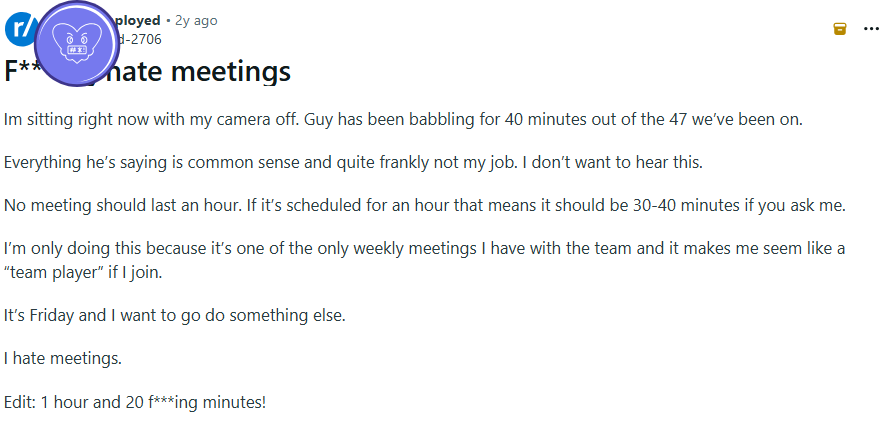
If your employees are creating anonymous accounts on social media just to vent about how you conduct meetings, maybe it’s time for a change.
Most entrepreneurial businesses struggle with productive meetings, and many leadership teams admit they’re holding too many meetings with too little impact with team meetings that feel like an endless loop of status updates, small talk, or conversations that go nowhere.
That’s exactly why the Entrepreneurial Operating System® (EOS®) built a simple, structured agenda called the Level 10 Meeting™….a weekly meeting rhythm that helps keep your team focused, aligned, accountable, and moving toward your quarterly goals.
As a Business Coach and Professional EOS Implementer®, I’ve helped dozens of teams transform the way they meet using this agenda. Below, I’ll walk you through exactly how I run my L10 meetings™, step by step, so you can take the same approach and get better results with your own team.
(P.S if you’d rather watch me discuss this with my template, I’ve created a video for you here)
Why the EOS® Level 10 Meeting™ works

The Level 10 Meeting (or “L10”) isn’t just another meeting…it’s the weekly operating rhythm for your business. When done right, it becomes the backbone of your leadership meetings, keeping everyone aligned, solving issues quickly, and ensuring accountability.
Most teams fail in meetings for the same reasons:
- Too much discussion, circling the drain, multiple people saying the same things, not enough decision-making
- No clear agenda
- No accountability to the previous week todo items
- Wasted time reviewing everything instead of what matters like quarterly priorities and weekly results
- A lack of consistent routines and regular “check-ins” or status updates that could have been sent in an email.
The EOS Level 10 meeting agenda solves all of this by giving you a strict proven agenda that happens on the same day, same time, same place, every week.
Here’s how I run it.
The EOS Level 10 Meeting Agenda (my exact process)
1. 5-Minute Check-In (personal + professional bests)
This first agenda item sets the tone. It’s fast…just five minutes..and it keeps the meeting in a positive tone.
Everyone shares:
- One personal best
- One professional best
This quick personal connection helps your team members stay engaged without drifting into just small talk. It builds trust, connection, and momentum right from the start.
2. 5-Minute Rock Review
Next, we review our quarterly rocks…the 90-day priorities that keep the business focused and moving toward achieving long-term goals.
Everyone answers ONE simple question:
On track or off track? 👍 or 👎
That’s it…no storytelling..no explanations or excuses..and certainly no deep dives.
If something is “off track”, we drop it directly to the issues list for later discussion and problem solving during IDS™ . This keeps the meeting moving and ensures your most important issues get prioritized, not buried. .
If you’re new to EOS, think of rocks as the highest-value quarterly priorities. A quick rock review ensures they get attention every single week.
3. 5-Minute Scorecard Review
Your scorecard review covers the 5–15 key company metrics that predict the success of your business. These are leading indicators…not lagging data.
Examples:
- Number of new client meetings completed
- Proposals sent
- Lead forms collected
- New contracts signed
- % outstanding AR beyond 45 days
Each rock owner or metric owner simply states whether their number is on track or off track.
And if it’s off, we simply drop it to the issues list.
Tracking these scorecard metrics weekly gives you a real-time understanding of whether your business is healthy…or if a new initiative you’re spending precious money, time, and resources on is actually working, and it helps you predict your future outcome instead of waiting for KPIs and financials at month-end.
4. 5-Minute To-Do List Review
Next, we review the to-do list from the previous meeting.
These are items assigned during IDS the week before.
A to-do is only complete if it’s fully done…no partial credit.
This step reinforces ownership, follow-through and real accountability across the team. It also helps reduce additional bandwidth like “whatever happened to that “thing”, did it get done?”
The goal is to complete at least 90% of to-dos every single week. It’s one of the biggest drivers of execution in the entrepreneurial operating system EOS.
5. 5-Minute Headlines

This is a space to share employee headlines, client news, or important updates (again, no lengthy discussion!).
Headlines are just that: concise, useful information.
And if it needs further attention, we just push it down to the issues list and priroritize accordingly.
This helps your team stay aligned with what’s happening across the business without derailing the meeting or burying the most important things that actually keep the business healthy Everything else is just noise.
6. IDS: Identify, Discuss, Solve (the heart of the meeting)
This is where the magic happens…and where most of your meeting time should go. EOS recommends that 60% of the meeting be dedicated to IDS.
IDS stands for:
- Identify issues at the root cause.
- Discuss possible solutions
- Solve the problem and assign a new to-do
This is how you run effective meetings, without letting meetings run you and your (frustrated by now) team members.
Here’s my exact approach:
Step 1: Prioritize the issues
You might have 20–40 issues, but you’ll only tackle the most important metrics first:
- Off-track rocks
- Off-track scorecard items
- Pressing issues that affect progress toward quarterly priorities
- Structural issues that create bottlenecks
- Anything affecting the health of the team
Tip: Start by calling out the top 3 issues you want to start with, and keep knocking them down 3 at a time. Whatever you don’t get to this week, you’ll keep on your short-term issues list and get to next week. Oftentimes your list needs a quick tidy up, what seemed important the weeks prior, typically winds up getting scrapped as you begin to focus on the most important things.
Step 2: Identify the root cause
This is critical. Most teams waste time solving the wrong problem, but the identify step forces clarity so you avoid circling around off track items. Ask yourself: what is this issue a symptom of?
Step 3: Discuss options
Have a short, focused discussion aiming to resolve problems. Not a debate. Not rabbit holes.
Everyone shares briefly and then moves on.
Step 4: Solve the issue
This means assigning:
- A to-do
- A next step
- Or a decision
When you finish solving an issue, mark it as “done” and move on to the next one.
IDS is powerful because it eliminates wasted time, rehashing issues week after week, too much discussion without action, etc
Rather, it ensures clarity, problem solving, decision making, progress and accountability
7. Conclude: Review and Rate the Meeting
At the end of the meeting, you:
- Clarify new to-dos
- Confirm next meeting date/time (though it should always be the same day/time)
- Rate the meeting from 1–10
A Level 10 meeting should feel focused, efficient, address real issues, accountable, energizing, and productive.
Anything below an 8 means the meeting needs improvement. Ask for feedback: If lower than an 8, ask “what would have made it a 10 for you?”.
How to make the Level 10 Meeting work for your team
Here are my key tips for running L10s well:
✔ Use the same agenda every week
Don’t customize it. The power is in the rhythm.
✔ Don’t skip the meeting
It’s your way of keeping the business healthy.
✔ Keep each section to its time limit
This prevents hijacking the meeting. Set a timer if you’re not using a software platform.
✔ Keep discussions out of the first 30 minutes
Everything goes to the issues list.
✔ Stay focused
No side conversations, no rabbit holes.
✔ Solve problems, not symptoms
Use IDS to get to the root cause.
✔ Don’t leave without clear to-dos
Every solve becomes action.
Final Thoughts: Transforming your leadership meetings
When you use the full EOS Level 10 Meeting Agenda, you’ll feel the difference in the very first week.
Your team will:
- Stay aligned
- Predict issues before they blow up
- Own their numbers
- Hit their rocks
- Solve problems fast
- Reduce the need for other meetings
- Maintain engagement and momentum
- Build trust and accountability
- Spend less time ranting on social media and you’ll spend more time moving the business forward.
And best of all? Your meetings will finally feel like they’re worth a 10 out of 10.

5 Responses