

“Traction made perfect sense. I took notes and followed the steps… but my business still feels like it’s not yet out of the weeds”

That’s what Joanne told me when she reached out for coaching. Like many entrepreneurs, she was pumped after reading Traction, the book by Gino Wickman (you can read the first chapter for free here). She understood that EOS® (Entrepreneur Operating System) could help her get unstuck and scale her tech consultancy business… but knowing and doing are two very different things.
So, here’s the problem: Joanne had the right vision. But not the discipline, consistency, and understanding of the depth of tools to actually follow through and get results. Plus it was ridiculously hard to implement a system while participating within that system.
As a business coach and Implementer, I’ve coached dozens of business owners like Joanne. They are ready to use EOS®, but unsure how to implement it: go it alone, use AI guidance, or hire a certified expert?
To help you cut through the noise and figure out which approach actually makes the most sense for your business, let’s discuss all three options. But before we delve in, here’s my take as an EOS® implementer.
My take on EOS® implementation

So, here’s what implementing EOS® looks like in “real life”. By the way, if you’re new to the Entrepreneurial Operating System (EOS®), I know it might sound like yet another set of business buzzwords.
However, it really is a practical, proven set of tools and an operating system designed to help leadership teams bring vision, simplicity, clarity, and consistency to their organizations. At its core, EOS® is built around six key components that every business worth its salt needs to master: People, Vision, Data, Issues, Process, and Traction.
Implementing EOS® in your organization looks like your leadership team coming together to define your company’s vision and core values. Next, you use foundational tools like the Accountability Chart™ to clarify roles and responsibilities so that everyone knows who’s doing what, setting clear expectations and hiring the right person for roles needed in the business.
However, as your business evolves, the tools you need to unlock the next level also evolve. As a business visionary, you need to be fully on board and engaged with the right tools and systems you need for each specific stage of your business growth. If you’re half-assed about it or not fully engaged, you end up worse off – because you think you’re doing the right things, but don’t have much to show for it.
The entire EOS® process is structured around a series of focused meetings, starting with the Focus Day (where you lay the groundwork), followed by Vision Building Days (to set long-term direction), and Quarterly Meetings (to keep everyone aligned and on track, executing the vision, and driving a healthy company culture).
The beauty of this model is that it’s simple yet laser-focused. It helps your entire company break down complex business challenges into manageable steps, while creating accountability, solving issues at the root cause, and achieving measurable growth and scale.
Three ways to implement EOS® in 2025

EOS® Self-Implementation
Taking on EOS® by yourself can save you money and let you move at your own speed. Many businesses choose to self-implement EOS®, relying on free resources and tools to guide their journey. You’ll get to know the system with time and build strong internal know-how. Plus, you’re free to adjust things to suit your operations.
Self-implementers use freely available resources like the Traction Library, Weekly Scorecard, and other EOS® tools to guide their implementation process. While this option might save money and build internal expertise, it requires a deep understanding of the EOS® framework, a passion for the system, and the discipline to have tough conversations and stick with the process. This last part is the most important piece. Self-implementing teams must discover for themselves the right balance between focus and flexibility to achieve lasting results.
But here’s the catch: trying to self-implement EOS® is a lot like learning a new language without a guide. Sure, your team might kick things off with an L10 meeting, but it’s easy to get tripped up …. tracking the wrong metrics like lagging vs. leading, feeling uncertain about sections like To-Do’s or Headlines (which can feel awkward at first), or struggling with having the right people in the right seats to drive accountability.
Without expert guidance, it’s easy to miss the mark on your Rocks and Scorecard, leaving you frustrated and not seeing the results you hoped for..Consistent practice is key, and teams that are disciplined and consistent are more likely to succeed. And without someone keeping you on track, it’s easy to fall off course.
For self-implementation to work, all team members need to be engaged and committed. If you’re a startup, watching your budget, or have a team that’s good at staying focused, you might find success going solo.
Leveraging AI tools for guidance
A middle-ground to self-implement EOS® is using AI tools for guidance. AI tools can help you save money while giving you more structure than going it alone. These tools are always there when you need them, offering templates, reminders, and tracking tools that make the process smoother. AI tools can help teams track leading indicators and lead activities that drive business results, as well as assist in identifying issues early so you can solve problems proactively.
Some people use AI tools as a 24/7 assistant to keep meetings on track, watch numbers, and help document everything. However, they can’t read the room or pick up on team tension like a real person can and won’t notice that Sarah from accounting rolls her eyes every time ‘marketing strategy’ is mentioned!
This option fits well if you have a tech-friendly leadership team that likes trying new things. It’s especially good if you’ve already dipped your toe in EOS® and want some extra support without the full cost of a professional guide.
Using a certified expert, EOS® Implementer Coach
Working with an Implementer is like having a skilled coach in your corner. An EOS® Implementer is a trained expert who guides leadership teams through the EOS® journey, helping them master and strengthen their business through the lens of the EOS® model and implement a complete set of foundational tools. Driving results and team health..
With a professional EOS® implementer by your side, your team benefits from expert facilitation, accountability, and support during tough conversations. The implementer helps you create and refine your Accountability Chart™, define your Core Values, and set Quarterly Rocks, ensuring your implementation process stays on track. This approach is ideal for businesses that want a structured, proven path to results and team health and are ready to invest in professional EOS® guidance.
But let’s be honest – it’s not cheap. You’re looking at $20,000-75,000 yearly. Plus, you’ll need to follow a set schedule and methods (because they work!) rather than making up your own rules. You’ll also have to be ready to decide on priorities and next steps as part of the implementation process.
This option shines for growing companies with 10+ employees or teams that need someone to hold them accountable. You can think of an EOS® Implementer as your business GPS – they’ll keep redirecting you when you drift off course or begin to ignore warning signs, even if that means making a U-turn!
Cost-Effectiveness Analysis
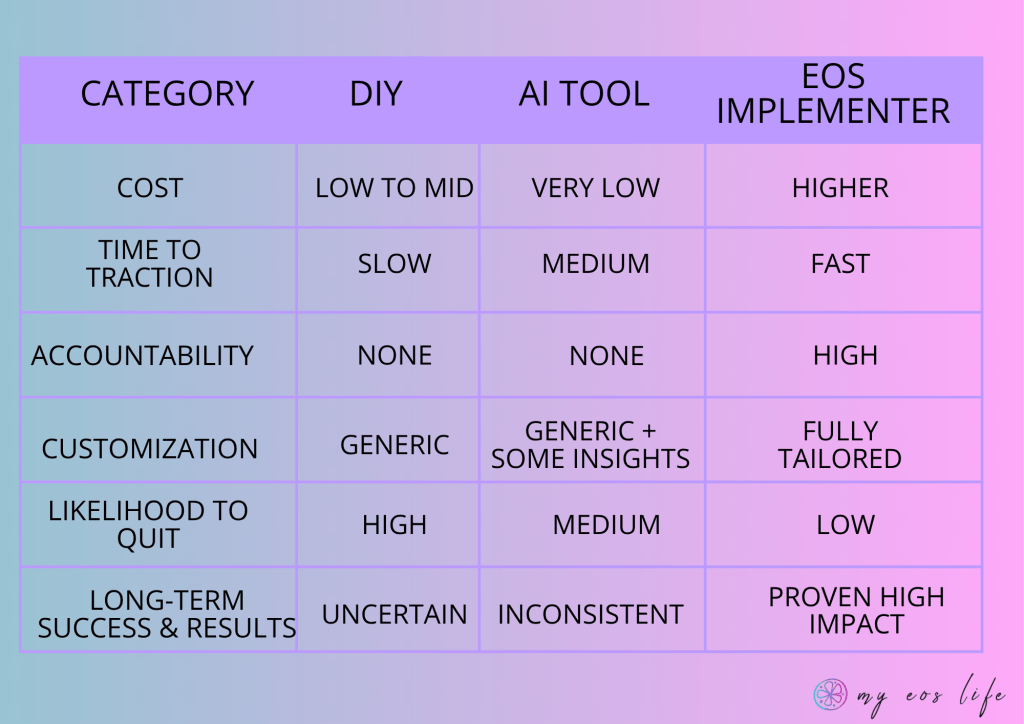
Now, let’s talk money and break down what each EOS® option will cost you. If you’re going at it solo, you’ll spend about $100 on books, $1,500 on software, and maybe $6,000 on online tools and courses. However, be prepared to lose time fixing mistakes or spending extra hours learning the ropes.
AI tools usually run $50-500 monthly, based on what features you want. This costs more than self-study but less than hiring a pro. You can start small and add more as you grow.
Professional help comes with the biggest price tag – think $3,500-10,000 per session depending on the Implementer’s fee structure and session locations. Full programs run $20,000-75,000 yearly. Yes, some clients think that this is a big number, but growth-minded companies often get their cost-effectiveness analysis worth through faster results and fewer hiccups.
Pick your preferred EOS® implementation option based on your company’s size, how fast you need results, and what you can spend. Remember – cheaper isn’t always better if it takes twice as long to get where you’re going!
Ease of Use and Commitment Level
Going solo with EOS® means you’re in charge of keeping everything on track. You’ll need rock-solid self-discipline and a team that stays motivated without someone checking in. It’s like being your own gym trainer – the tools are there, but you have to show up and do the work. Without external support or accountability, there’s a real risk of getting stuck on unresolved issues or losing momentum.
Getting started with AI tools means you’ll have ready-made templates and friendly reminders. However, you’ll need to be comfortable with technology and willing to input data regularly for the best results.
Working with a pro is the most straightforward path. A pro will handle the heavy lifting. But you’ll need to block out time for quarterly full-day sessions and monthly check-ins.
This is 1/65 “working” days every quarter that you’re dedicating to working ON your business. When you think about this, it’s pretty hard to argue that your business isn’t worth that. Also if you’re going this alone, reinventing the wheel for each quarterly or annual planning meeting can become laborious and a little stressful.
[CTA: Ready to work with a professional EOS implementer? Book a call with me now.]
Impact on Leadership team alignment, culture, and long-term success

When you handle EOS® on your own, your team might feel more ownership of the process since they’ve learned it from the ground up. The EOS® implementation process can also positively impact the lives of team members, both professionally and personally, by fostering growth and well-being. However tough conversations about team health can often get pushed aside without someone there to guide you through. Success boils down to how well your leaders stick to the plan month after month, and the capacity to dedicate additional time to taking on learning the system and preparing for meetings on their own.
AI tools help keep everyone on the same page with clear goals and numbers everyone can see. They’re great at keeping the daily stuff running – like scorecards and meeting schedules. These tools can also support teams in solving issues efficiently, but they may miss the human element where real culture change happens.
Working with a pro usually gets teams aligned the fastest. Professionals like me have seen it all before and know how to spot issues that could slow you down. We’ll push you to have those uncomfortable but needed talks that make teams stronger. Think of EOS® implementers as your team’s mirror – showing you blind spots you didn’t know you had.
Your chosen approach should be based on business needs and core values
As a general rule of thumb, EOS® works best for teams of up to 10+ employees and > $2M in revenue. However, there are some outliers to this rule.
While small companies (with under 10 employees) might succeed with self-implementation and some AI help using tools like the Vision/Traction Organizer and Level 10 Meetings, most companies usually get the best results working with certified pros. This is because when running multiple departments, having an expert guide helps orchestrate efficiency simultaneously across multiple departments.
Your best approach would depend on your team’s track record with projects. If your team is good at following through, self-implementation might work. However, if your team needs an extra push, professional help could be worth the cost.
It’s also worth remembering that EOS also strengthens middle management, without which your entire leadership team would fail miserably.
Making Your EOS implementation choice
There’s more than just your budget to consider if you’re going to implement the entrepreneurial operating system effectively. You’ll need to find what works best for your team’s culture, goals, and resources.
Self-implementation gives you freedom but demands discipline, AI tools offer a middle ground with 24/7 support, and certified implementers provide the fastest route to results (though at a premium).
If you’re ready to stop spinning your wheels and actually get traction? Whether you’ve tried going it alone or experimented with AI tools, there’s no substitute for having an expert in your corner. As a certified EOS® Implementer, I’ve helped leadership teams like yours cut through the noise, build real accountability, and scale their growth. If you’re serious about scaling with less chaos and more clarity, let’s talk. Book a discovery call today and see if a guided EOS implementation is the right move for your team.
Ready to work with a professional implementer? Schedule a call with me here.
